
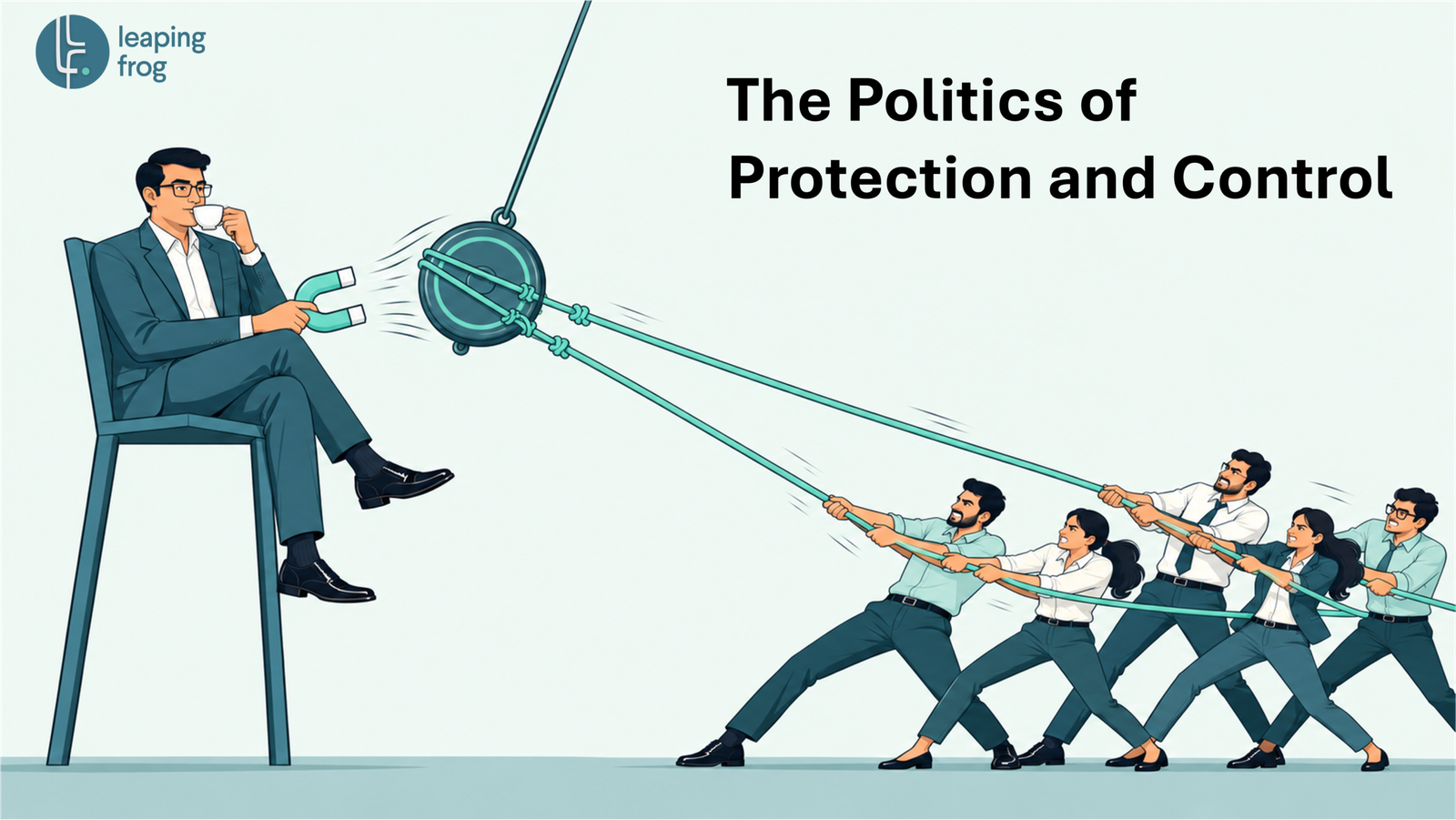
How an organization learns mistrust and then gets blamed for lacking ownership.
The demand for ownership
“Why don’t people take ownership?”
It makes sense that the CEO feels frustrated. The organization needs people willing to go beyond their job descriptions, solve problems across departments, and step up when needed. But employees often seem cautious, protective of their areas, and reluctant to go beyond their usual roles.
Before judging employees for not stepping up, ask: What has this organization shown people about what happens when they take initiative?
The problem might be that leaders want employees to take ownership but don’t give them enough authority. People are encouraged to go beyond their roles, but when they do, they often find they have little real influence.
When control becomes a message of mistrust
Consider a typical decision. A manager suggests something, but the CEO checks with another manager, consults another department, and returns with more questions. Everyone is involved, but it is unclear whose opinion matters. The next time, the manager hesitates to act.
The leader might see this as thorough. But the manager could see it as a lack of trust, thinking: My judgment isn’t enough. My work needs to be double-checked.
Why and how checks are done matters. If verification is open and based on clear standards, it can build trust. But if checks happen repeatedly and without explanation, it can send the message that people aren’t trusted. Control then becomes more than just a process. It affects relationships and can lead to unhealthy workplace politics.
These experiences add up across the organization. Decisions about hiring, pay, policies, and even small matters often end up with top leaders. While tasks are delegated, decisions aren’t final until a leader approves them. People are given responsibility, but not real authority.
People start to wonder whether the organization will support them when they exercise their own judgment. They learn to protect themselves before acting.
How the organization learns to protect itself
Edgar Schein’s work explains how leaders shape culture by what they focus on, control, reward, and model. An organization might say it values initiative, yet people may learn that exercising independent judgment is risky.
This pattern spreads downward. When leaders at the top are controlling, others learn to protect themselves by controlling what’s below them. When a department head’s judgment or decision is rechecked with others without their knowledge, it can feel like mistrust. They may start holding back information, limiting who gets involved, and exercising tighter control over their own team. Job boundaries turn into protective walls. People stick to what feels safe and wait for instructions. Leaders see this caution as a lack of ownership and respond by tightening control, which only worsens the problem. Leaders see employees as untrustworthy, while employees feel they aren’t trusted to take responsibility.
The organization can get stuck in a cycle where reactions to mistrust only create more mistrust.
Protection and control start to feed off each other. People control their area to feel safe, and protect it to maintain control.
Mistrust can make this cycle even worse. When coworkers get involved, it can feel threatening, and their questions can seem suspicious. People start to question motives:Why do you need this? Who told you to ask? Will this be used against me? As a result, cooperation declines.
This creates an uncomfortable contradiction. Leaders ask people to go beyond their roles, yet at the same time show that boundaries must be tightly controlled.
The organization is told to be open but doesn’t see its leaders model that openness.
The unconscious life beneath the organization
Over time, these habits become part of the organization’s culture. No one needs to say, “Protect yourself.” New employees quickly learn when to stay quiet, whom to copy on emails, and which decisions require unofficial approval. Mistrust becomes normal; this is just how things work here.
There’s a set of unwritten rules:Don’t become too exposed. Don’t share more than you have to. Don’t act without protection. Hold on to what’s yours.
You can see these hidden patterns in everyday actions: someone holds back an update, escalates an issue that doesn’t need it, copies too many people on an email, refuses to collaborate, or leaves a decision hanging. These instances reveal the organization’s true beliefs.
In a study of 51 manufacturing teams, Amy Edmondson found that psychological safety was linked to behaviors, which in turn were linked to team performance. Asking questions and discussing mistakes means taking risks with others, something a protective culture discourages (Edmondson, 1999).
What the organization must confront at the top
Before asking people to change, leaders must confront what their own behavior has taught the organization about staying safe. When decisions are rechecked without their owners’ knowledge, authority is quietly reclaimed, and independent action invites suspicion; people learn to protect themselves. Guarding information, defending boundaries, and securing approval become ways of surviving.
The politics of protection takes hold when staying safe becomes more important than stepping forward.
Calls for ownership will have little meaning until leaders examine their part in making protection necessary: What in my behavior makes people afraid to act? What happens when someone exercises judgment I would not have exercised?
Change begins when people experience authority that holds, disagreement that can be expressed safely, and mistakes examined fairly. These experiences must remain dependable under pressure. If control returns at the first sign of difficulty, people learn that trust is temporary and self-protection remains necessary.
With repetition, these experiences can change the unspoken assumptions governing how people work. But the first shift must come from those whose behavior has made control the model for everyone else.
People will struggle to step beyond their protective boundaries while leadership continues to make those boundaries necessary.
Until leaders make that space real, the complaint that “people don’t take ownership” needs to be met with a tough question:
“How much ownership are leaders truly willing to give others?”
References
Edmondson, A. (1999). Psychological safety and learning behavior in work teams. Administrative Science Quarterly, 44(2), 350–383. https://doi.org/10.2307/2666999
Menzies, I. E. P. (1960). A case-study in the functioning of social systems as a defence against anxiety: A report on a study of the nursing service of a general hospital. Human Relations, 13(2), 95–121. https://doi.org/10.1177/001872676001300201
Schein, E. H. (2004). Organizational culture and leadership(3rd ed.). Jossey-Bass.
Authored by: Sanjay Gupta, Principal Consultant, Leaping Frog Consulting Services.
Author’s note: “The politics of protection and control” is an interpretive framing. The proposed cycle connecting leadership control, mistrust, and employee self-protection draws on the cited research and theory; these studies did not directly test it as a causal model.


Leave a Reply
Your email address will not be published. Required fields are marked *